Client: California Water Service (Cal Water)
Location: Las Lomas, Monterey County, CA
Flow Rate: 350 GPM
Contaminants Treated: Hexavalent Chromium Cr(VI), Iron, Manganese
Engineering Consultant: Corona Environmental Consulting
Technology Provider: ATEC Water Systems (a Cadiz Company)
The Las Lomas water system, operated by California Water Service (Cal Water) since 1988 as part of its Salinas District, serves a small rural community in Monterey County relying entirely on groundwater.
The system comprises:
- Two groundwater wells
- Three water storage tanks
- Four booster pumps
Cal Water ensures operational reliability, regulatory compliance, and water quality through extensive testing, conducting 1,389 tests across 144 parameters in 2023 alone, meeting all state and federal standards.
REGULATORY CHALLENGE: HEXAVALENT CHROMIUM COMPLIANCE
In 2014, California adopted a maximum contaminant level (MCL) of 10 parts per billion (ppb) for hexavalent chromium (Cr(VI)), significantly more stringent than the federal 100 ppb limit for total chromium. The new regulation created immediate compliance challenges for groundwater systems across the state, particularly in regions like California’s Central Coast, where naturally occurring Cr(VI) is commonly found in groundwater.
At Las Lomas Station 305, part of California Water Service’s Salinas District, untreated groundwater contained an average Cr(VI) concentration of approximately 12 ppb, exceeding the newly adopted state MCL. Recognizing the need to protect public health and maintain regulatory compliance, Cal Water began evaluating treatment technologies capable of reliably reducing Cr(VI) while integrating with the station’s existing treatment infrastructure.
Rather than wait for compliance deadlines, Cal Water took a proactive approach, launching a chromium treatment program across several affected facilities. Station 305 was selected as one of the first sites for implementation, with ATEC’s chromium treatment system commissioned in 2015. Since then, the system has consistently delivered compliant drinking water. According to Cal Water’s 2023 Consumer Confidence Report, treated water leaving the facility contained Cr(VI) concentrations ranging from 1.9 to 5.1 ppb, with an average of 2.9 ppb, demonstrating the long-term effectiveness of the treatment system.
ATEC’S SOLUTION: ADVANCED RCF TECHNOLOGY
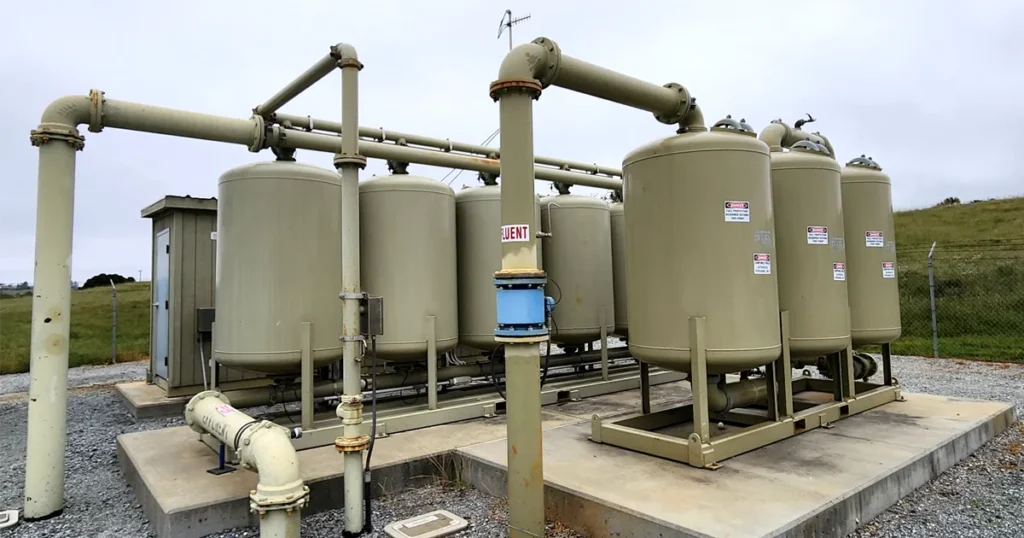
To address hexavalent chromium (Cr(VI)) in the Las Lomas water supply, Cal Water partnered with ATEC Water Systems and Corona Environmental Consulting to design and implement an effective, scalable solution. The project centered on Station 305, which had already been outfitted with iron and manganese treatment equipment. Rather than replacing the entire system, ATEC engineered a targeted retrofit that added chromium treatment capabilities to the existing infrastructure.
The selected approach was ATEC’s Reduction-Coagulation-Filtration (RCF) process—a well-established and California Division of Drinking Water–approved method for removing Cr(VI). This process reduces Cr(VI) to trivalent chromium (Cr(III)), a less harmful and more easily filtered form.
Key Treatment Steps:
- Ferrous chloride injection: Reduces Cr(VI) to Cr(III).
- Chlorine oxidation: Converts iron(II) to iron(III), which improves chromium filtration.
- Manganese dioxide–coated silica sand media filtration: Removes total chromium, iron, and manganese ensuring compliance with state drinking water standards.
The retrofit integrated with the existing iron and manganese treatment vessels, enabling rapid deployment without service disruption. This minimized capital costs and avoided major infrastructure changes.
Corona Environmental Consulting provided pilot testing, design optimization, and regulatory coordination, ensuring full alignment with California’s drinking water treatment requirements.
RESULTS: RELIABLE COMPLIANCE AND COMMUNITY PROTECTION
Operational since 2016, the Las Lomas system has delivered consistent performance, as reported in Cal Water’s 2023 Consumer Confidence Report:
- Average Cr(VI)concentration: 2.9 ppb
- Range of detection: 1.9–5.1 ppb
- Regulatory status: Fully compliant with California’s 10 ppb MCL
The system’s success underscores ATEC’s expertise in delivering scalable, low-maintenance solutions that protect public health. Las Lomas residents benefit from safe, compliant drinking water, with no customer action required.
KEY BENEFITS
Proven Expertise: ATEC’s RCF technology, validated across numerous installations, ensures reliable Cr(VI) removal.
- Seamless Integration: Retrofitting existing infrastructure minimized operational impacts.
- Community Protection: Consistent compliance safeguards Las Lomas’ water supply.
- Efficient Deployment: Rapid implementation maintained service continuity.
- System Modularity: ATEC filtration vessels are the key component in both iron /manganese and chromium removal systems.
WHY ATEC STANDS OUT
The Las Lomas project exemplifies ATEC’s leadership in Hexavalent Chromium Cr(VI) treatment. By combining innovative RCF technology with strategic partnerships, ATEC delivered a solution that meets California’s toughest standards while prioritizing community safety and system reliability. This success positions ATEC as a trusted partner for water utilities facing similar challenges.